
Macro-region, innovation and complementary currency: the programme of Maroni
The President of Lombardy Region presented his governing document to the council: “Fighting the economic crisis, combating organised crime, and reducing the cost of politics.”
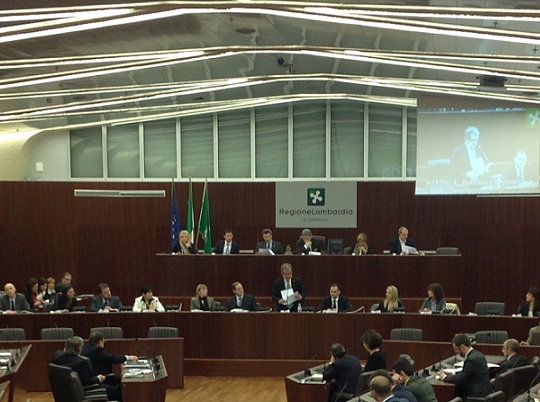 Carrying on and improving. Carrying on with the work already done by the previous governments, but also pursuing the “age-old” proposals of the Northern League; improving the region’s performance, and looking to Europe with a new perspective. Roberto Maroni, the President of Lombardy Region, presented his governing programme to the regional council. His three main objectives are, “To fight the economic crisis, combat organised crime and all forms of illegal activity, and reduce the cost of politics.” In the twenty-five pages of his speech, which he read to a silent chamber (for the record, Maroni remained afterwards, for the whole of the debate that followed, a clear sign of change with respect to his predecessor, Roberto Formigoni), the President outlined the proposals in his “governing programme, which sticks closely to the document with which I stood in the elections.”
Maroni touched on many subjects: work and businesses, health and welfare, legality, schools and universities, Expo 2015, the environment, the public administration and the institutions; all starting from the two main points of his election campaign, “the establishment of a macro-region in the North and the allocation, to the regions, of no less than 75% of the overall tax revenue collected in those regions.” He then mentioned another idea (in addition to replacing the tax collection company Equitalia), that clearly bore the mark of the League. “In short-term periods that are characterised by a credit crunch, the development of new forms of payment can encourage the exchange of goods and services, so we are going to continue the feasibility study of a complementary currency system, also by involving the main stakeholders, such as banks, associations, institutions and Chambers of Commerce.”
Of course, a lot of space was dedicated to the economic crisis and employment. “Over the next few years, we intend to allocate subsidies to start-ups, to reintroduce and to value training apprenticeships, to make contributions in the art sectors, to introduce tax bonuses for the first five years for businesses started by people under the age of 35, to introduce incentives and deductions for the artisan businesses that employ people under the age of 30, and to distribute to local administrations taxes for the creation of incubators for young enterprises.” For businesses, the new council promises “a package of shock measures”, which include “€500 million to pay the debts that local authorities in Lombardy have towards small and medium-sized business.”
On the matter of health, Maroni praised the results achieved so far (“We have a health system that costs the taxpayer less than all the others, that provides better services and more opportunities,”), but he wants to “establish a foundation for a new leap in quality.” And so, the governing programme mentioned “reorganising the number of local health authorities and hospital units and their work, by differentiating the social-health services provided in accordance with the standard of treatment intensity; developing a network care model in hospitals, for the treatment of serious diseases; reducing the waiting lists by increasing the specialisation of hospitals; establishing standard costs for purchasing and providing health and social-health services; and enhancing the hospital units, to guarantee continuity and integration of all care services.”
And there are also changes for transportation and infrastructure. Maroni confirmed that “he wants to speed up the final realisation of the priority works already started by the previous council, such as the Pedemontana motorway, the new Milan bypass and the Brescia-Milan motorway,” and mentioned changes, such as “a genuine liberalisation of the rail service, which would lead to better and cheaper services by establishing genuine competition between operators.”
Maroni also dedicated space to the institutions, and to transparency in the public administrations and local authorities. “The regional stability pact that we’ve had in Lombardy since 2009 has produced positive results. In 2012, the ceiling set on local authorities was €210 million, in part allocated to municipalities involved in the Expo and to those hit by the earthquakes. This is an important measure, at a time of crisis; during this legislature, we will continue to encourage and develop the Pact, which will also be extended to municipalities with fewer than 5000 inhabitants.”



Dalla Home
Varese
Lago di Varese mai così basso in inverno e la pioggia ancora non si vede
Varese
Chiesti oltre 30 anni di carcere per la “Banda Vasi”
Castelveccana - Milano
Omicidio di Castelveccana, iniziate le perizie balistiche
Cronaca
Prima a Malpensa e poi in ospedale a Gallarate, ricostruite le ore prima dello schianto mortale in autostrada
La community di VareseNews
Loro ne fanno già parte
Ultimi commenti
mike su La neve in montagna continua a sciogliersi. Contro la siccità si aspetta la pioggia
Felice su La festa "techno" nei boschi di Lonate Ceppino causa proteste
Rolo su Pullman in sosta con i motori accesi, la segnalazione e la risposta di Autolinee Varesine
lenny54 su "C'è del dolo nelle modifiche al Superbonus"
Felice su Architetti, geometri, ingegneri e costruttori all'unisono: "Da Super Bonus a Super Malus"
Felice su Dentro la loggia del Battistero di San Giovanni a Varese restituita alla città









Accedi o registrati per commentare questo articolo.
L'email è richiesta ma non verrà mostrata ai visitatori. Il contenuto di questo commento esprime il pensiero dell'autore e non rappresenta la linea editoriale di VareseNews.it, che rimane autonoma e indipendente. I messaggi inclusi nei commenti non sono testi giornalistici, ma post inviati dai singoli lettori che possono essere automaticamente pubblicati senza filtro preventivo. I commenti che includano uno o più link a siti esterni verranno rimossi in automatico dal sistema.