
“History teaches us nothing”
For International Holocaust Remembrance Day, the Curie High School, in Tradate, invited Vera Vigevani Jarach, who fled, when she was ten years, because of the racial laws, and who saw her daughter kidnapped and killed during the Argentinian dictatorship.
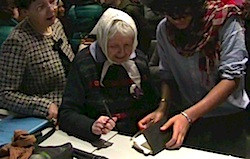 “History never teaches us anything. What happened in the past continues to be repeated in small and large situations. This is why we mustn’t forget, but remain on the alert, to be sure that none of this happens again. It isn’t over yet.”
To remember Holocaust Remembrance Day, the Curie High School, in Tradate, invited Vera Vigevani Jarach, who, at the age of ten, fled with her family from a Milan that was beginning to experience the drama of the Holocaust and the racial laws, and, about 40 years later, on 27 June 1976, she was struck by the immense pain of seeing her daughter Franca kidnapped and then tortured and killed, at the age of 18, during the Videla dictatorship in Argentina.
Vera’s life is one that has been marked by hatred and persecution, which has left a deep scar on her soul. Today she is a tireless witness of the values of solidarity and hope. “I speak to the young, to the children because what happened didn’t happen by chance, but at the hand of a crazy visionary. It was the crystal clear planning of a precise project. And some of the signs can be seen today, outbursts of intolerance, prejudice, and racial hatred. Those who flee a country are driven by a desire to find the promised land, to leave desperation and horror behind them. Also thousands of Jews tried to escape, sailing to Palestine, but they never reached their destination.”
Fascism, Nazism, dictatorship. “What made these abominations possible was silence. The silence of those who looked the other way, of those who watched without opposing, who hid. Liliana Segre told me that when they were transported from San Vittore Prison to the station to leave for Auschwitz, only the prisoners said goodbye and wished them all the best. The people in the street who saw them marching onto the coaches seemed to be blind and deaf. And so, for years, the desaparecidos in Argentina remained invisible shadows because of media silence, of the indifference of the other nations.”
Vera told the children of the night when her infant school teacher came to her home to tell her mother that she couldn’t go to school anymore. “We saw that things were becoming delicate. So my mother had the strength to react and she convinced my father to flee. My grandfather wanted to stay, and so ended his life in a concentration camp. And then, in 1976, my husband and I understood that the situation was getting worse, but we couldn’t react. At the beginning, when we still thought that we would find Franca, we were thinking about leaving. But she never came back and I discovered only 20 years later how she had died. It was a terrible story but I needed to hear it. Franca was a person, a story, and she had a right to her story.”
Looking back Vera does not regret going to Argentina. “When my family and I arrived, the country welcomed us with open arms. We were allowed to study, to grow up and become adults. What happened later on was horrible; my husband and I didn’t have time to realise what was about to happen to us.”
What unites the two persecutions she suffered was the attempt to dehumanise the enemies, to make them numbers, and to take away their dignity, in order to be able to kill them. “But in doing this, it was they who lost their humanity. It is man who decides what he wants to be, and it’s this freedom that has to be controlled, because deviation is always possible.”
To react and not turn your head, solidarity and justice, these were the lessons that Vera gave the children of the Curie High School. “You mustn’t be paralysed by fear. The secret is not to be stopped but keep on moving, mind and body, in order to find the solution. When we mothers of Piazza De Mayo gathered for the very first time, the policeman tried to turn us away because it was forbidden to gather. He told us to keep walking. It was then we had a flash of inspiration; we began walking around a statue and as we continuously circled the statue, the group became bigger and bigger. We were scared, of course we were, but we didn’t give in.”
The guest of the Curie High School was like a flowing river. For years, she has been meeting Argentinian and Italian children; she listens to them and she encourages them to reflect. “In Argentina, we say ‘Nunca mas’.”
The testimony of Goti Bauer, the guest at Insubria University
The story of Vera and her daughter Franca



Dalla Home
Varese
Lago di Varese mai così basso in inverno e la pioggia ancora non si vede
Varese
Chiesti oltre 30 anni di carcere per la “Banda Vasi”
Castelveccana - Milano
Omicidio di Castelveccana, iniziate le perizie balistiche
Cronaca
Prima a Malpensa e poi in ospedale a Gallarate, ricostruite le ore prima dello schianto mortale in autostrada
La community di VareseNews
Loro ne fanno già parte
Ultimi commenti
mike su La neve in montagna continua a sciogliersi. Contro la siccità si aspetta la pioggia
Felice su La festa "techno" nei boschi di Lonate Ceppino causa proteste
Rolo su Pullman in sosta con i motori accesi, la segnalazione e la risposta di Autolinee Varesine
lenny54 su "C'è del dolo nelle modifiche al Superbonus"
Felice su Architetti, geometri, ingegneri e costruttori all'unisono: "Da Super Bonus a Super Malus"
Felice su Dentro la loggia del Battistero di San Giovanni a Varese restituita alla città






Accedi o registrati per commentare questo articolo.
L'email è richiesta ma non verrà mostrata ai visitatori. Il contenuto di questo commento esprime il pensiero dell'autore e non rappresenta la linea editoriale di VareseNews.it, che rimane autonoma e indipendente. I messaggi inclusi nei commenti non sono testi giornalistici, ma post inviati dai singoli lettori che possono essere automaticamente pubblicati senza filtro preventivo. I commenti che includano uno o più link a siti esterni verranno rimossi in automatico dal sistema.