
From a Garage in Cadrezzate to a start-up in Dublin
It is called Clamphero, and it is a gadget designed and produced by a young man from Cadrezzate and his friend from Lodi, using a computer and a 3D printer. But now they need you.
 The story of Davide and Niccolò is one of two normal young men with a common wish: to find a job. The two met at the European Joint Research Centre, in Ispra. Davide was about to graduate in Physics, at the State University in Milan, with a specialisation in renewable energies. Niccolò was providing assistance for the dozens of computers at the JRC. At the end of the internship, they said good-bye but did not lose contact. Davide graduated, and Niccolò decided to move to Dublin, where he found a job in an insurance company. Davide explained, “Immediately after graduating, I started looking for a job in the research and development field for renewable energies. I sent out dozens of CVs, to ENI, ENEL, A2A, ST, a company that produces semiconductors, that collaborates with the energy giants, but I didn’t even get one reply. It was like a rubber wall.”
It was then that Niccolò invited Davide to join him in Ireland. “We wanted to do something together, to invent a job for ourselves.” In the Emerald Isle, they found the perfect conditions for starting a company. “For our start-up, we only needed an e-mail address, a meeting with a business consultant and €300.” And so, GarageGeeks was born. The name is reminiscent of the companies begun in garages during the 1970s, like Apple and Microsoft, and of the bespectacled geeks with a passion for computers and new technologies.
What does GarageGeeks do?
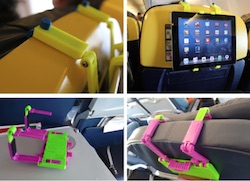
“At the moment we produce a gadget from biodegradable plastic, which we’ve called Clamphero. This is an idea that Niccolò had during a flight to Malaga. Basically, it’s a holder for a mobile phone, or tablet, that attaches to the seats and allows you to watch what you want without getting a stiff shoulder or a crick in your neck. So, after that flight, we started looking to see if there was anything like it around.”
And was there?
“Actually, there are a lot of supports, but they’re all designed to be fixed inside cars. Nothing for airplane seats, or for other modes of transport. For this reason, we decided to design the first prototype, using a 3D design program; then we printed it out using a 3D printer, and finally, we registered the design of the product.”
Designing an idea is one thing, but going into production is very expensive.
“Yes, it is. We made an estimate, by going to some printers, and worked out it would take €50,000 to produce a few thousand pieces. Of course, we didn’t have that much.”
So, what did you do?
“We decided to organise a micro-funding campaign on Kickstarter, an online crowdfunding platform, presenting our idea to the web. It was pointless asking for a large amount of money, so we decided to start by asking for €6000 to produce a certain number of Clampheros. We’d be able to produce up to 100 with our printer. But if we reach the required amount, we’ll buy 6 more 3D printers to start our production.”
How is the fundraising going?
“We’ve nearly raised €4000, but if we don’t reach the €6000 mark, all of the money will go back to those who paid it. In fact, GarageGeeks gets the money, only if the sum is reached.”
What does the backer get, when he or she decides to support your idea?
There are several “prizes”, depending on how much is offered. I’ll give you an example: if you give €120, we’ll give you five Clampheros. If a company decides to support us, we’ll produce the pieces it needs, and so on.”
How much time is there until the end of the crowdfunding campaign?
“There are exactly 6 days, on Friday 19, the campaign ends. Kickstarter gives each project 30 days.”
Why didn’t you launch this initiative in Italy?
“There are lots of crowdfunding platforms; in Italy, for example, there’s Indiegogo, but Kickstarter is the most important and best known in the world. It’s a pity you can’t launch projects in Italy.”
Apart from Clamphero, are you developing any other projects?
“In fact, Clamphero is only the first idea. We’d like to buy consumable materials, such as electrical resistors, capacitors and things like that, to develop projects in the domotics field. Our idea is to make electronic technology smart and available to everyone.”
Good luck!
“Thanks.”



Dalla Home

Varese
Lago di Varese mai così basso in inverno e la pioggia ancora non si vede
Varese
Chiesti oltre 30 anni di carcere per la “Banda Vasi”

Castelveccana - Milano
Omicidio di Castelveccana, iniziate le perizie balistiche
Cronaca
Prima a Malpensa e poi in ospedale a Gallarate, ricostruite le ore prima dello schianto mortale in autostrada
La community di VareseNews
Loro ne fanno già parte
Ultimi commenti
mike su La neve in montagna continua a sciogliersi. Contro la siccità si aspetta la pioggia
Felice su La festa "techno" nei boschi di Lonate Ceppino causa proteste
Rolo su Pullman in sosta con i motori accesi, la segnalazione e la risposta di Autolinee Varesine
lenny54 su "C'è del dolo nelle modifiche al Superbonus"
Felice su Architetti, geometri, ingegneri e costruttori all'unisono: "Da Super Bonus a Super Malus"
Felice su Dentro la loggia del Battistero di San Giovanni a Varese restituita alla città










Accedi o registrati per commentare questo articolo.
L'email è richiesta ma non verrà mostrata ai visitatori. Il contenuto di questo commento esprime il pensiero dell'autore e non rappresenta la linea editoriale di VareseNews.it, che rimane autonoma e indipendente. I messaggi inclusi nei commenti non sono testi giornalistici, ma post inviati dai singoli lettori che possono essere automaticamente pubblicati senza filtro preventivo. I commenti che includano uno o più link a siti esterni verranno rimossi in automatico dal sistema.